

It’s probable that 2020, a dystopian-feeling era of stay-at-home orders, social distancing and global health crisis, may seem like a distant fever dream. However, 2020 and the COVID pandemic exposed inequalities and exploitation that still persist into the present.
One such inequality was uncovered over the summer of 2020 as garment factories in the UK city of Leicester, supplying the fast fashion brand Boohoo, were revealed to be practicing deeply exploitative labour practices; this included failure to comply with national minimum wage requirements and disregard of social distancing measures.
Reflecting over five years later, this article considers the impact of this fast fashion exposé and its broader implications for how the industry continues to operate today. 2026 is a critical time for us all to revisit this scandal, as online ultra-fast fashion retail (exacerbated by the likes of Shein, Temu and Aliexpress) continues to boom in profitability at the same time as global, social, and environmental catastrophe unfolds.
Social Repercussions of Fast Fashion: Exposing Leicester’s Hidden Sweatshops
The Sunday Times published an article over the summer of 2020 reporting that employees working in the garment factory ‘Jaswal’, located in the city of Leicester, were being paid as little as £3.50 an hour. This shocking failure to comply with the national minimum wage of the time (set over £5 higher at a rate of £8.72) was subsequently linked directly to the production of garments for Boohoo-owned brand Nasty Gal.

The impact of this report did not stop there. The shameful exposé ultimately opened a Pandora’s box of exploitative labour practices occurring in Leicester garment factories, more appropriately categorised as sweatshops, implicating Boohoo in allegations of modern-day slavery.
Boohoo’s failure to comply with minimum wage laws within their supply chains emphasised to UK residents that the garment industry’s reliance on cheap labour, rather than being confined within the Global South, was playing out on their very doorsteps. Consequently, the exploitation integral to fast fashion brands, such as Boohoo, became increasingly challenging for the British public to ignore, or often (wrongly) brush off as part and parcel of life elsewhere in the world.
Following The Times’ exposition of Leicester’s garment industry, a reporter at the BBC interviewed factory worker Paramjit. Paramjit highlighted how, despite earning between £3 and £5 an hour, an official investigation into their pay would likely conform to minimum wage requirements. This occurred as Leicester-based factories covered their tracks through methods such as falsifying the hours being worked by employees and forcing workers to repay parts of their wages to the factories.
Consequently, beginning with the initial Sunday Times exposé, the intricate workings of financial exploitation in garment factories, from which Boohoo profited, began to be unravelled.

In addition to wage corruption, the Times article also highlighted how COVID-19 restrictions were not being met within these factories. At the time of writing, a local lockdown was ongoing, and the British public were freshly exposed to the suffering that Covid had created within their lives, as well as disproportionately within the lives of disadvantaged members of their communities. As such, the shock of the article was amplified as it revealed how garment workers, already faced with extreme economic precarity, were additionally being disproportionately exposed to this virus.
The impact of the exposé was represented in a sharp decline in Boohoo’s share price – a scenario suggesting that consumer choices are indeed swayed by the ethics of a brand’s production.
However, the year is now 2026, and Boohoo is still making a very healthy (solely in economic terms, of course) profit. So what has happened in this time to enable this? And why do we continue to fail to create sustained changes to the industry following fast fashion scandals?
The Boohoo Scandal in 2026: The Fast Fashion Exploitation/Rebranding Cycle
Following Boohoo’s media attention, stimulated by the damning reports of labour exploitation in Leicester’s garment factories, the company’s shares fell by 42%. This represented a substantial loss of over £1 billion in market value.
Yet this did not signify the end of the road for Boohoo.
Boohoo distanced themselves from the Leicester factories, claiming that they were unaware of the garment producing company involved in the scandal (problematic in itself through the indication that the supply chain’s lack of clarity meant Boohoo themselves were unaware of its details) and the following year, Debenhams acquired Boohoo. From this, a swift rebranding began under the Debenhams group name.
As part of this rebrand, the scandal was superficially acknowledged. Access to annual modern slavery statements is available through their website, which provides broad, ambitious and ultimately nonaccountable actions to be “a business that is fair to all, and we are working hard to live up to this.”
Additionally, the company created the Boohoo Garment and Textile Workers Trust – a trust designed to improve workers’ conditions, but with which there is negligible information available online regarding both the aims and, most importantly, tangible actions of the group.
Ultimately, under this new ownership, the company has continued to be profitable. This profitability relies on implementing the same old tactics of ultra-fast fashion: low-priced garments, constant sales and the rapid production of micro trends, to name a few.

At the core of these tactics remains the necessary low-cost production of garments, which is ultimately facilitated through labour and environmental exploitation.
Hence, it is impossible for Boohoo’s rebrand and commitment to tackle unjust labour conditions to go beyond purely superficial rhetoric. Contrastingly, it is simply representative of a surface-level PR move strategically implemented to save the reputation of the company.
This highlights a broader trend within fast fashion – one considered in our article on the greenwashing cycle. This cycle is identified as involving the five steps of:

This greenwashing cycle, executed by other brands such as H&M, is deeply dangerous as fast fashion companies find more innovative ways to continue to implement the same exploitative practices under the false pretence of social and environmental responsibility. Ultimately, this makes it more difficult to highlight and fight against their exploitation as the line between truly sustainable and greenwashing brands becomes more difficult to comprehend.
A top tip to avoid falling into the greenwashing trap is to ignore buzz words emphasised by brands, and instead look for evidence of tangible actions. Eco-Stylist’s ratings are a quick and easy way to differentiate between greenwashing and real sustainability.
Fast fashion brands, such as Boohoo, do not care about making real change in the face of scandal. PR strategies are employed purely to save face and, ultimately, save profit. Hence, Boohoo continues to thrive in 2026 through the same disastrous tactics it was using in 2020.
Fast Forward to 2026 …
Last year Boohoo’s CEO earned a staggering £4,528,393. In stark contrast, the fate of the affiliated garment workers provides a much bleaker picture; the scandal of 2020 has meant that, by 2026, Boohoo has outsourced most of its supply chain to the Global South, where exploitation is often less visible, and labour laws tend to be more lax. As a result, garment workers in Boohoo’s supply chain (although relocated) continue to be mistreated. Simultaneously, many Leicester factory employees have lost livelihood-sustaining jobs, creating a lose-lose situation for all workers at the bottom of the supply chain.
Fundamentally, what this demonstrates is a model of fast fashion that is completely dependent on inequality.
So, let’s now move on to highlighting five eco-stylist-approved alternatives to Boohoo, which reject this fast fashion model and instead support mutual benefits for people and the planet.
Five Sustainable Alternatives to Shop Instead of Boohoo
1) MATE the Label

MATE the label is your go-to for shopping for comfortable, yet stylish, athleisure – a market which was heavily adopted by Boohoo in 2020. Its clean and timeless aesthetic is perfect for providing a wardrobe stable through both the seasons and years.
2) Pangaia

Similar to MATE the label, Pangaia is perfect to shop for high-quality, sustainable athleisure. Designed through timeless silhouettes, yet incorporating feminine colourways, Pangaia is the perfect place to shop for eco-friendly comfort.
3) Whimsy and Row
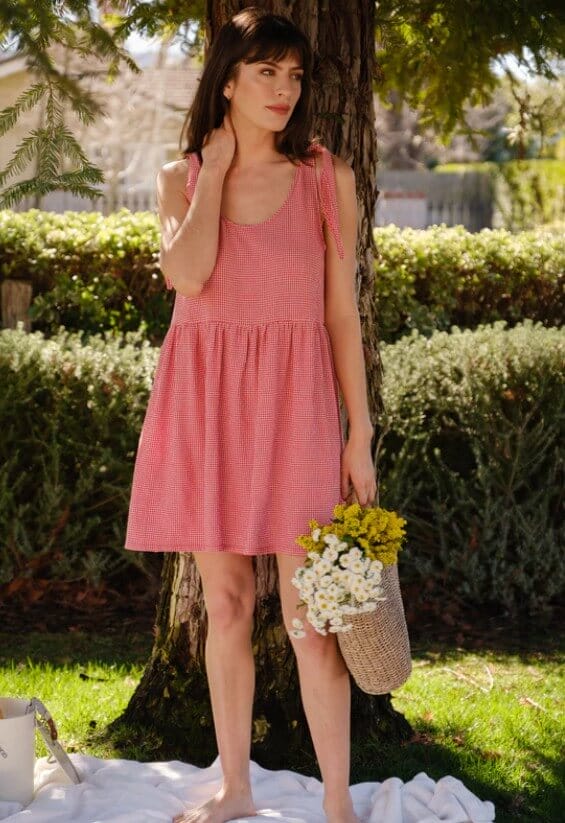
If you are looking for an alternative to the feminine silhouettes provided by Boohoo, yet also want to embrace a more timeless and versatile look which is not reliant on micro trends, look no further than Whimsy and Row. This low-impact company aims to provide “ease and elegance for the modern sustainable woman.”
4) Dedicated

Dedicated offers an alternative source of bold colours, prints and patterns. Yet, contrary to Boohoo’s adoption of cheap materials and labour, Dedicated is committed to using organic, natural and recycled fibres in combination with wholly transparent and traceable supply chains.
5) Reformation

For sustainable dresses, Reformation specialises in distinctly feminine garments and occasion wear. The brand, in contrast to the practices of boohoo, is a member of the Fair Labour Association, as well as being a Climate Neutral Certified brand.
Want Even More Sustainable Alternatives to Boohoo?
For more environmentally and socially responsible alternatives to Boohoo check out our other article on Boohoo alternatives, and for even more see Eco-Stylist’s full sustainable fashion brand guide.
Through acknowledging the fast fashion’s scandal/greenwashing cycle, then subsequently breaking this cycle through shopping for more sustainable alternatives, we come one step closer to reaching a sustainable future for the fashion industry.

Rhona is studying a Master’s degree in Global Development and Environment at the University of Bristol. She also works in sustainable retail and, in her downtime, enjoys reading, thrifting and yoga.


