
I’ve been writing about Everlane since 2019.
Back then, we ran them through our sustainable brand criteria and they failed — 30 out of 100. The “radical transparency” brand promise felt more like a tagline than a reality. I published the results, our community shared them, and something unusual happened: Everlane actually listened.
Over the next several years they did the work. Sustainable materials, supply chain transparency, certifications, packaging improvements, a repair and resale program. Their score climbed from 30 to 43 to 69. Earlier this year they earned our Gold rating — the highest we give.
I meant every word of it when I said it was one of the most meaningful brand transformations I had ever seen in this space.
On May 16, 2026, Everlane’s board approved a deal to be acquired by Shein.
Effective immediately, we are removing Everlane’s Eco-Stylist certification.
Why the Everlane-Shein Deal Changes Everything
I want to be direct with you, because that’s what we’ve always been about here at Eco-Stylist.
Shein is not a gray area. It is not a brand working toward improvement. It is not a company that failed our criteria and is on a journey to do better. Shein is the single most destructive force in the fashion industry today — a company built on a business model of extreme overproduction, alleged labor abuses, and a volume of environmental damage that is genuinely difficult to comprehend. They are the textbook definition of everything that conscious consumers are fighting against.
When a company like Shein acquires a brand, they are not buying it to make it more sustainable. They are buying its credibility. They are buying the trust that customers like you spent years giving to Everlane. They are buying the “radical transparency” story and the Gold certification and the loyal community that believed in what Everlane was building.
That is not something I’m willing to be a part of.
Our certification exists to help you make decisions you feel good about. It is a signal of trust — my trust, and Eco-Stylist’s trust — that a brand is genuinely aligned with our values. The moment Shein became Everlane’s owner, that signal became meaningless. I can’t in good conscience point you toward a brand and say “we trust them” when the company signing the checks is Shein.
So the certification is gone. And I want to explain exactly why, and what this means for you.
A Brand That Earned It — And a Loss Worth Mourning
I don’t say any of this lightly. The Everlane decertification isn’t a story I’m happy to tell.
What makes it harder is understanding how we got here. Everlane wasn’t sold because the brand failed. It was sold because the finances did. The company had accumulated roughly $90 million in debt, and majority owner L Catterton needed an exit. Shein — valued at over $60 billion and flush with cash — was the buyer. The deal values Everlane at approximately $100 million, a steep discount from the $250 million-plus valuation it commanded at its peak.
That context matters. This isn’t a story about Everlane’s leadership abandoning their values. It’s a story about what happens when a brand’s ownership structure doesn’t protect those values — and private equity runs the clock.
But I also want to give credit where it’s due, because our community was part of this story. You shared our 2019 article. You emailed Everlane. You commented on their posts. You voted with your wallets and your voices, and — as Orsola de Castro of Fashion Revolution reminds us — every time a brand hears from one customer, they assume it represents 10,000 people. Your voice had weight. And Everlane responded to it.
Over the years that followed, they expanded their use of sustainable materials, signed the Transparency Pledge, published deeper supply chain information, built a repair and resale program, eliminated all virgin plastics from their packaging, and earned certifications including GOTS, RWS, and the Good Cashmere Standard. Their score climbed from 30 to 43 to 69 — and eventually to a Gold rating, our highest.

That’s what makes this so gutting. Everlane did the work. And now that work — and the trust it generated — has been handed to Shein.
What Shein Ownership Actually Means for Your Wallet
I want to address something I know some of you are already thinking: Does it really matter who owns the brand if the product stays the same?
It’s a fair question. And the answer is yes — it matters enormously.
Ownership is not a technicality. It determines where money flows, what values drive decision-making, and what future the brand is actually building toward. When Shein owns Everlane, every dollar you spend at Everlane ultimately benefits Shein. It funds their ecosystem. It props up a parent company that is, by any honest measure, one of the most harmful actors in the global fashion industry.
Let me be specific about what I mean by that. Shein operates on a model of ultra-fast fashion at a scale the world has never seen before. They add thousands of new styles to their platform every single day. They have faced repeated allegations of labor abuses in their supply chain, including reports of workers earning below minimum wage for excessive hours. They have been cited for intellectual property theft by independent designers on a massive scale. Their environmental footprint is staggering — synthetic, petroleum-based fabrics, near-zero transparency into their manufacturing, and a business model engineered for disposability.
This is not a company that is on a sustainability journey. This is a company whose entire existence depends on the world continuing to consume as much cheap, disposable clothing as possible, as fast as possible.
Everlane’s values and Shein’s values are not just different — they are opposing forces. And when opposing forces merge, it is never the more powerful one that changes.
Why We’re Removing the Certification — And What Our Standards Require
At Eco-Stylist, our certification isn’t just a score. It’s a statement of trust.
When we certify a brand, we’re telling our community: we have looked at this company carefully, we believe they are aligned with our values, and we feel good recommending them to you. That recommendation carries weight because we take it seriously. We re-evaluate brands regularly. We update ratings when brands improve — and when they don’t. We have failed brands that others were calling sustainable. We have celebrated brands that did the hard, unglamorous work of actually getting better.
That integrity is the whole point. Without it, we’re just another platform with a green leaf logo.
Our three core principles for certification are simple:
1. The brand is not fast fashion.
2. The brand inspires us.
3. We trust the brand.
Everlane, under Shein ownership, cannot pass a single one of these.
Shein is the defining fast fashion brand of our era. A brand in their portfolio cannot credibly claim to stand apart from that model. There is nothing inspiring about watching years of genuine progress get absorbed into a company built on exploitation and disposability. And trust? Trust requires transparency, accountability, and alignment of values. I cannot trust a brand whose parent company has made a business out of doing the opposite of everything we stand for.
Removing this certification was not a difficult decision. It was a necessary one.
Where to Shop Instead
If Everlane has been part of your wardrobe, I understand the frustration of losing a brand you trusted. The minimalist aesthetic, the quality basics, the denim — it was a genuinely good product backed by genuinely improving ethics. Losing that is real.
But the good news is that the sustainable fashion space has grown significantly since we first started covering it, and there are brands doing everything Everlane was doing — and doing it without the Shein problem.
Here are three Eco-Stylist certified brands that match Everlane’s aesthetic and product range closely:
1) Outerknown
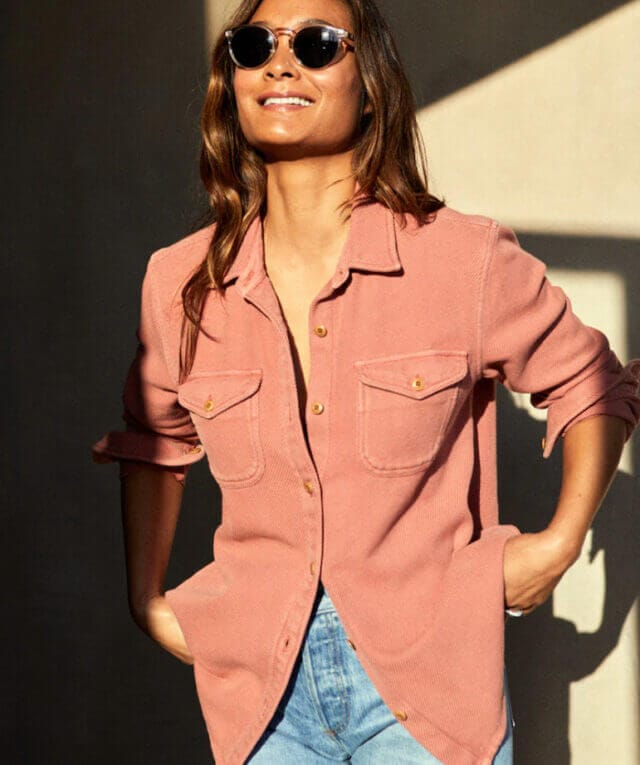
Outerknown is one of our Gold-rated brands, and for good reason. They offer a strong range of wardrobe essentials — quality basics, denim, outerwear — for both men and women, built on a foundation of serious supply chain accountability. They use over 95% preferred fabrics, meaning nearly everything they make is produced with lower-impact materials. They also have a pre-owned program, so you can buy and sell preloved Outerknown pieces — great for your wallet and for keeping clothes out of landfill.
2) Asket

Asket is built on a philosophy of permanence — they make a limited, fixed collection of wardrobe essentials and refuse to add new styles just for the sake of it. No seasons, no trends, no sales. Just well-made, thoughtfully designed pieces that are meant to last. They publish a full impact receipt for every garment, breaking down exactly how much carbon, water, and energy went into making it. That’s radical transparency, actually delivered.
3) Ninety Percent

Ninety Percent makes quality, minimalist wardrobe staples — sweaters, tops, dresses, bottoms — in the same clean, timeless aesthetic Everlane built its following on. Their name says it all: 90% of distributed profits go back to the people who make the clothes and the causes they support. Certified organic materials, solid supply chain transparency, and a genuine values story to match.
For the men who loved Everlane’s basics, Taylor Stitch is worth a look too.
Your Trust Is Worth Protecting
I started Eco-Stylist because I believed that people deserved honest information about the brands they support. Not greenwashing. Not vague sustainability claims dressed up in pretty packaging. Real information, held to a real standard, updated when things change.
The Everlane story — from a failing score in 2019 to a Gold rating in 2025 — was one of the most hopeful things I had witnessed in this space. It was proof that consumer pressure works. That brands can change. That the sustainable fashion movement isn’t just idealism — it’s a force that companies actually respond to.
And then, in a single acquisition announcement, it became something else entirely. A cautionary tale about what happens when a brand’s values aren’t protected by its ownership structure. A reminder that progress in this industry is never guaranteed, and that the work of holding brands accountable never really stops.
Everlane’s certification is removed.
If you have questions, drop them in the comments below. And if you want to explore brands that are still earning your trust, our full Brand Guide is the place to start.
Dress like you give a damn.
— Garik


