
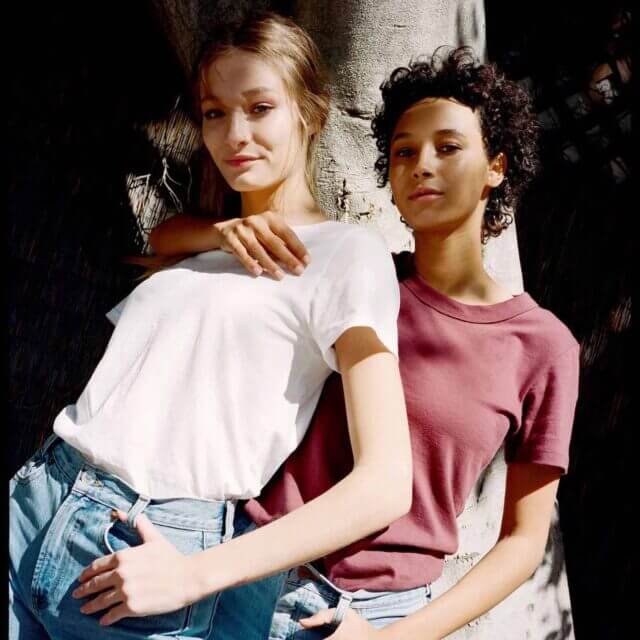
For Days started as a sustainable clothing brand, with a closed-loop subscription model, where you could buy a package of 3-10 T-shirts and swap them to be recycled into new garments. For basics that would regularly end up in landfills, this was a game changer.
Its clothes were Global Recycled Standard Certified, they were free of any harmful chemicals and produced under SMETA standards for worker health and safety as well as labor standards.
What is For Days Offering Today?
Five years after its foundation, For Days doesn’t even appear to sell products from its brand any longer, even though the brand name still appears on their A-Z brand list.
It is instead a “recycling and rewards platform” with a marketplace of what have been described as sustainable brands on the UN Fashion Website.
They recycle clothes by offering to send you a bag where you can put your old clothes of any brand to be shipped, sorted, and recycled by them.
Our Old Rating of For Days Sustainability
We used to certify For Days as a sustainable brand. We felt comfortable doing so because they were transparent, even if they had room for improvement like not having a publicly available code of conduct. They showed that they worked with factories in the US, Portugal, Morocco, and Turkey. They used to work with Hallotex as a supplier, for example.
The brand used to provide the workers with fair wages, as it was part of the fair labor and worker health SMETA certification requirement. It also destined 1% of each order to advance education in Morocco.
Their basics were made with Organic Cotton (GOTS certified), and dyed with dyes certified for being Cradle to Cradle. Since their clothes were made to be recycled back into new garments, they were also Global Recycled Standard certified. Their recyclability was powered by a swap program business model, which was a huge part of our rating because it meant that garments did not end up in landfills.
They also used to offset transportation CO2 emissions by contributing to a project that reduced methane.
Overall, their score was 63, enough for Silver and a great score at Eco-Stylist.
How is For Days Doing Now? Our New Sustainable Brand Rating
Since For Days appears not to have plans to sell their own branded clothes anymore, this makes rating them a lot more complicated. They are now a marketplace and a recycling platform with rewards to spend on other brands.
With the info they currently offer on their website, they only score 17.
Keep reading to see what we found.
Is For Days Transparent?
For Days shows the numbers in terms of the impact its recycling program has. Their recycling service, “The Take Back Bag”, diverts 15lb of textile waste from landfills, and 95 lbs of CO2 emissions according to their website. However, they do not disclose how they arrived at these CO2 calculations.
On their stats, they say that 74% of their clothes are sorted for reuse but it is unclear how this reuse is done. Where do people access these clothes to reuse them? For Days does not have a reused clothing section and resale at a global scale also has its issues. The other 15-20% is used for fabric recycling and 5% ends up in landfills. It is not explicit who their recycling partners are.
By using a Take Back Bag, people instantly earn $20 “Closet Cash for future circular fashion purchases”. This is the other part of For Day’s business today, the marketplace. What we look for in a sustainable marketplace is the peace of mind that it is curated according to holistic environmental and social factors, so that consumers’ lives and decisions are made easier.
How sustainable or circular are the brands they host then? There is nowhere to be seen a list of criteria with which the brands they offer are chosen. This comes close to greenwashing.
If they were to sell their brand items now they would have zero transparency, no info on factories, mills, or a code of conduct.
Is For Days Sustainable?
Let’s look at the different aspects of For Days’ sustainability efforts. First, are they sustainably made?
Since they are no longer offering their products, the fact that they used natural, recycled, and non-hazardous chemical fabrics is no longer relevant nor can it even be found on their website.
Does it have a clothing recycling program? A look at For Days Take Back Bag

For Days is a recycling program. With their Take Back Bag, you choose from small, medium, or large ones, wash your clothes, linens, towels, or curtains from any brand, and put them on the bag with a prepaid shipping label. They will then sort them: some will end up being cleaned and resold (although it isn’t clear where), others fabric to fabric recycled, and the rest will be down-cycled for other uses of recycled material like paper-making, and fortifying building materials.
In terms of the impact this program has, their website says as of 2023 they have sold 275K bags and diverted 5.5M garments from landfills. This means 41.5 Million pounds of CO2 have not been emitted, 439 Million gallons of water have been saved, and 3.7 Million pounds of clothing from landfills.
The bag itself is said to be 100% recyclable, 50% post-consumer recycled content, and fully recyclable.
Is For Days a sustainable marketplace?
What we hope to find in a sustainable marketplace is a curation of brands that have been dutifully vetted and the disclosure of how that process was made as well as a code of conduct. Are the brands they offer transparent? Do They use fair labor? Are they owned by BIPOC or underrepresented communities? Are their products sustainably made?
At Eco-Stylist, we too are a sustainable marketplace and we only carry brands we can certify. On our website you can see the criteria we use: we assess brands on three main themes: Transparency, Fair Labor, and how Sustainably Made their clothes are. We also consider whether the brand is not fast fashion, if it inspires us, and if we trust the brand.
Brands that get 50 or more points enter our directory and can earn Certified, Silver, or Gold Standard, depending on how deep their actions are. A wholesome explanation of this is also included in a YouTube video that fully explains our rating methodology if anyone wants to dive deeper.
We also make our impact readily available. In terms of Transparency, 83% of our brands share detailed information about where and how their clothes are made. 59% share detailed information about the rest of their supply chain. When it comes to Fair Labor, 78% of our brands are making progress on living wages. And in the Sustainably Made category, 93% of our brands use a majority of more sustainable materials like hemp, linen, TENCEL, and organic cotton across their entire brand.
Now, if you look at For Days there is no information on how they choose the brands they feature in their marketplace. No criteria.
Of their A-Z of brands, we can only vouch for a few that we have certified ourselves: Known Supply, Subset, Wolven, Saola Shoes, Arvin Goods, and Whimsy + Row.
Whereas the brands that have failed our criteria included in their marketplace are: Able, Alohas, Cariuma, DL1961, Harvest & Mill, Parks Project, Paneros, and Understatement, among others.
There is also no mention of trying to offset or reduce CO2 emissions in the shipping of either the trash bags or the marketplace sales.
Additionally, For Days also lets buyers use the $20 Trashiecash they get for each bag as well as earn cashback with other external brands and websites, some of which are sustainable like Pact, and others which certainly are not like Amazon.

Is For Days Ethical?
To see how ethical or not For Day is currently, we need to take a look at factors like their labor standards and their diversity and inclusion.
Does For Days use fair labor?
When it was a brand, For Days was SMETA-certified. We knew they were founding 1% of each order to build schools in their factory’s community in Morocco. This is no longer available on its website.
Now, as a Marketplace, we don’t know what wages the workers are earning, or what they look for in the brands they promote. There is also no code of conduct that the brands in their marketplace should follow to ensure their sourcing is sustainable.
It is likewise on their website they do not say who their recycling partners are for the Take Back Bag program, and as such it is not possible to know whether they pay their workers fairly or if they are treated under good conditions.
The last information available on that was on the UN website back in August of 2022. It stated that it partnered with Hallotex, Leigh Fibers, and Phoenix Fibers, there is no way to check whether or not this is still current.
Diversity, equity, and inclusion
For Days does not disclose its hiring practices or show its company makeup, aside from its founders, both of whom are women.
Sustainable Brand Alternatives to For Days
Even though we are sad we can’t certify For Days any longer, that doesn’t mean there aren’t basic brands out there that are fighting the good fight, which we would stand behind. Check out our top three alternatives.
1) Pact

Pact is a brand we can stand behind. They produce garments that are GOTS-certified and Fairtrade. Their clothing also does not use any harmful chemicals or toxic dyes.
2) Known Supply

Known Supply is an ethical clothing brand built on transparency, dignity, and human connection. The brand partners with Fair Trade Certified™ factories and pays living wages, while also going a step further by openly sharing the names and stories of the people who make their clothes—putting faces to fashion in a way few brands do.
Their collections use GOTS-certified organic cotton, low-impact dyes, and responsible manufacturing practices designed to reduce environmental harm. Known Supply focuses on timeless, everyday essentials rather than trend-driven fashion, encouraging longer wear and more mindful consumption.
By combining certified fair labor standards, organic materials, and radical transparency, Known Supply offers a strong alternative for shoppers looking to support ethical fashion rooted in both sustainability and social justice.
3) ASKET

ASKET is a minimalist clothing brand focused on creating permanent essentials designed to last. The brand uses GOTS-certified organic cotton across many of its products, along with recycled and responsibly sourced wool, prioritizing durability and long-term wear over trend-driven fashion.
Transparency is central to ASKET’s approach. Each product includes detailed information about its supply chain, including the factory, material origin, and cost breakdown—allowing customers to understand how and where their clothes are made. ASKET also supports circularity through its Repair Program, encouraging customers to extend the life of their garments rather than replace them.
For shoppers looking for high-quality basics backed by traceable sourcing and a commitment to longevity, ASKET is a strong ethical alternative.
For more sustainable brands where you can get your wardrobe staples, with peace of mind, check out our brand guide!
Editor’s Note: This article was updated on January 18, 2026, to ensure the ethical alternatives listed represent our best current sustainable alternatives to For Days.

Adela is a Colombian storyteller, content maker, strategy consultant, & event producer, specializing in sustainable fashion, mental health, and gender issues.


