

How sustainable is buying exclusively second-hand?
At first glance, you might think the answer to this is obvious. But second-hand fashion sustainability may not be as straightforward as it appears.
Currently, there are two dominant approaches to consuming fashion sustainably (excluding making clothes yourself): buying second-hand and buying new apparel from certified sustainable retailers. Whilst both strategies share the same aim – to break the relationship between fashion and its contribution to socio-environmental disaster – they are accompanied by contrasting associations. Whilst sustainable brands are associated with a sense of economic inaccessibility, second-hand shopping is considered as a win-win solution to both the planet and our bank accounts.
As a recent graduate, this is a narrative I came across regularly as a student. Unsurprisingly, in my Geography degree, the disastrous impact of the fashion industry was a commonly shared concern among fellow students. However, a pretty universal experience is also the cost-savvy, bargain-hunting nature of student life. Thrift shopping, Depop scrolling and vintage hunting have come to define many young people’s approach to sustainable fashion. In fact, more than 40% of Gen Z and Millennials claim they buy a second-hand product at least every few months. So, are young people defining the path to a sustainable future for the fashion industry?
In short, not quite yet. Currently, 92 million tonnes of garments end up in landfill annually. Additionally, fast fashion is still dominating the market, now producing two times the amount it did in 2000. These figures are suggestive of a less optimistic reality – one where second-hand shopping remains a far way from realizig an optimal outcome for people and the planet.
Of course, that is not to say that second-hand shopping isn’t miles better than fast fashion – it is, and it’s beginning to challenge fast fashion in new and exciting ways. But perhaps it is just one element of a more holistic solution to combating the current (un)sustainability of the fashion industry.

Conscious second-hand consumerism: why buying used alone falls short
As highlighted, it’s likely you might consider second-hand and new sustainable shopping as existing in two very different camps – the conscious middle-class professional versus the conscious student, perhaps? But what if this is a limiting mindset? What if bridging this divide between the new and the old of sustainable fashion could offer us the solution we need to transform the industry …
One of the main arguments for incorporating new, sustainable fashion brands into a second-hand wardrobe, and why a completely second-hand approach to fashion may still fall short of being completely sustainable, relates to our psychological relationship to buying clothes. An impactful report by the Hot or Cool Institute highlights how we should be buying no more than 5 new garments per year.
Whilst this specifically relates to new clothing, it more generally provokes a major conceptual shift in our relationship to consumption. The managing director of this institute, Lewis Akenji, brought second-hand shopping into the equation, stating that whilst he wouldn’t consider a second-hand garment one of the five, it would still equate to more than 50% of one of these items.
This somewhat grey zone regarding the extent to which buying more is okay if it is preloved is perhaps second-hand shopping’s biggest downfall. I will admit that I can be guilty of justifying unneeded purchases with the excuse “it’s fine, it’s vintage!” If you add to this the thrill of a bargain, then there is the potential for second-hand shopping to continue the unsustainable relationship between fashion and our addiction to overconsumption.
So, how can incorporating new, sustainable brands into your wardrobe help? The answer comes down to our mindful consumption. When we are faced with a higher price point, supply chain transparency and the five items/year limitation suggested by the Hot or Cool Institute, it prompts us to consider our purchasing decisions more deeply. Questions regarding the production, material composition and our real requirements become much harder to ignore – considerations which are often brushed over when justifying a purchase as “a second-hand bargain!”
Factoring in sustainability considerations is drastically important when buying clothes, both second-hand and new. This is because every garment in circulation has a lifespan. 24 billion items of used clothes were exported to the Global South in 2024 as a result of second-hand donations to charities such as Oxfam, and this inevitably adds to the earlier-mentioned 92 million tones of textiles ending up in landfill. It goes without saying that fast fashion is the leading villain in perpetuating textile waste; however, we cannot trick ourselves into believing that just because of shopping second-hand, we relieve ourselves of the responsibility to think critically about our consumption.
What’s more, the supply chains of secondhand shopping are growing increasingly complex. Pakistan is the leading importer of secondhand garments, however, new research reveals it is now also the 11th largest exporter of secondhand clothes as well. As such, buying secondhand does not necessarily mean buying locally, something which has implications for transport-related CO2 emissions. It doesn’t necessarily mean a lengthened lifespan either; a significant portion of the garments sold on second-hand sites such as Depop are fast fashion products with lifespans limited by their material composition and trend-influenced design.
Ultimately, second-hand or not, the clothes we buy still have historical and future trajectories and, often, these trajectories have stark costs to the planet. Second-hand markets can inadvertently conceal some of these costs. In the case of apps like Depop, there is even evidence that this concealment can also go beyond being accidental, as sellers have been caught using the platform to resell brand-new clothes from fast-fashion villains such as Shein under the guise of ‘vintage’.
Of course, second-hand shopping is still extremely valuable for keeping existing items in circulation. But that doesn’t mean that it is inherently perfect or always the correct option.
So, when should you shop new and when should you shop second-hand? This is how I would approach curating a wardrobe which combines sustainable apparel and second-hand gems in a way which is best for you and the planet, as well as your bank accounts (even for bargain-hunting students!).
When buying new (sustainably) makes sense
The best approach to conscious shopping is to set basic principles for how to shop. Whilst these will be slightly different for each individual, as a general rule of thumb, a good guideline to buying new is to focus on staple garments which don’t follow (micro)trends.
This is in line with considering the material composition of the garments and how this impacts their production and lifespan. Additionally, and this is what will differ person-to-person, it’s crucial to consider how the garments correspond to what you already own. This allows you to form cohesive outfits rather than owning disconnected (and therefore less utilized) individual items.
In line with the Hot or Cool institute, I have outlined five staple garments I would buy new if I had to start a wardrobe from scratch – although, despite their advice to purchase no more than five garments per year, these items shouldn’t need repurchasing for many years beyond that!
Classic white t-shirt
Eco-Stylist is reader-supported. If you make a purchase using our links, we may earn a commission. We only feature fashion brands that pass our sustainable brand criteria. Learn more here.
It’s pretty widely agreed on that a basic white t-shirt is the wardrobe staple. It is also a garment which occupies a spectrum of material compositions and price points. Although it may be a higher price point to buy a 100% organic cotton tee, in terms of cost-per-wear, it will become the cheapest item in your wardrobe. High-quality composition means you can constantly re-wear without worrying about it losing its shape or becoming discoloured. Plus, choosing natural materials over synthetic materials limits your exposure to microplastics – a win-win-win for the planet, your bank account and your health!
Some great options which are available to shop on eco-stylist include the 100% organic cotton long sleeve t-shirt from Asket. Or, for an elevated yet still timeless white tee, made from pesticide-free cotton, I love the Agathi Draped Top from Eco-Stylist Silver rated brand Ninety Percent.

Everyday jeans
If a simple white tee is the ultimate staple garment, then the ultimate staple outfit has to be styling it with the perfect pair of jeans. The various cuts of jeans available mean that everybody’s style preference for making you feel your best will be different. So, whilst there is some great denim available second-hand, a major advantage to buying denim from a sustainable brand is that the cut, leg and waist measurements can all be adjusted to suit your individual preference. By investing in one perfect pair of sustainably-certified jeans for all occasions, you can help to reduce the massive amounts of water waste involved in the production of denim, reduce your support for unethical labour practices and limit how much denim ends up in landfill.
For jeans which will last you a lifetime, you could look at Eco-Stylist Gold rated brand Nudie Jeans. The free repairs offered for the lifetime of the product mean you don’t have to worry about the impacts of wearing your jeans for everything, from evening out to active adventures.
For men, Nudie Jean’s Tuff Tony One Wash provides a staple straight leg which will never go out of style. In the women’s styles, the Clean Eileen are the perfect jeans to serve you through the seasons.
Black tailored trousers
Having one smart pair of trousers in your collection for lots of people is crucial; but regardless of whether you are required to dress smart for work, the beauty of black tailored trousers is that they can be dressed up and down for every occasion.

It is this versatility which makes them perfect for a sustainable wardrobe which focuses on getting the most wear out of less. The wide leg pants from tentree are an example of trousers which are able to go with everything and for every occasion – plus they are made from recycled materials!
Knit jumper
Wool jumpers are an example of how conscious shopping means you only need to do it once! Wool is a natural material which is also self-cleaning. As a result, it does not need to be regularly washed and– assuming you don’t put it in a hot wash!!! – knitwear can last you a lifetime. This means that the negative impacts of a new 100% wool jumper will be less severe than buying a synthetic jumper second-hand when considering their entire lifespans.
The Eastmoor Sweater from Taylor Stitch is an example of a versatile jumper which combines 100% RWS wool with timeless design.
For a women’s knit (although really a timeless knit jumper is also pretty genderless), the organic cotton and recycled cashmere blend Roma Sweater from Outerknown could be a great choice.
Functional outerwear
A knit jumper, black trousers, jeans and a white tee generally make up the most versatile (and therefore sustainable) basis of a wardrobe. But ultimately, what makes the most versatile things you own are normally also the most functional. And when it comes to functionality, nothing really compares to a coat that will serve you through all the seasons. Buying this second-hand can be tricky, as the technical elements of jackets massively vary and are dependent on correct garment care.
Consequently, it may be a good idea to invest in a new coat which you can look after and repair throughout the years. This can reduce the impact on the planet of buying a new jacket every season – a damaging cycle that the fast fashion industry perpetuates.

A good example of a technical and versatile jacket is Patagonia’s Nano Puff, which is lightweight, water repellent, insulated and also stuffs into its pocket to be packed away easily wherever you are using it. What’s more, like Nudie Jeans, Patagonia’s Iron Clad Guarantee means that you can get free repairs for the lifetime of the product.
Second-hand fashion sustainability: when should I still buy second-hand?
It may feel like I have been overly critical of second-hand shopping. That is not my intention. Rather, it is important to highlight that there is no silver bullet to making the fashion industry sustainable. Like with most societal progress, change generally necessitates a combined approach.
When it comes to tackling fast fashion, buying second-hand definitely still holds a significant role in contributing to this. So, in mind of some of the issues relating to second-hand shopping, here is a guide to some of the best things to grab preloved!

Leather goods
As highlighted in our article on the sustainability of leather, buying new leather is very difficult to do consciously, as it is reliant on the livestock industry – an industry responsible for almost 15% of greenhouse gas emissions. However, leather has a long history of being used in fashion, and its durable nature means that there is an abundance of leather items available to buy second-hand from vintage shops, thrift stores and flea markets.
What’s more, the design of leather jackets, boots and belts are generally timeless. Often, new brands are designing leather jackets to have a vintage style, so why not skip the middleman and go straight to searching for real vintage instead!
Occasion wear
Got a big event coming up? Weddings, university balls and proms are all examples of events that tend to come with a formal dress code. What also comes with this dress code is the tendency for clothes to be purchased and then never worn again (more so in the case of women, as suits are generally re-worn). This tendency opposes the entire approach to building a versatile wardrobe I have so far laid out. However, all hope is not lost! Buying second-hand for formal events is remarkably easy as a result of the single-use nature of these events.
When looking second-hand for occasion wear, it is still helpful to consider its potential versatility for a range of future events. This is encouraged through buying clothes in a practical colour, rather than season-specific/trending print. Additionally, by purchasing something which can be worn both formally and casually, it helps to ensure its wardrobe versatility.
The most important rule for buying occasion wear second-hand is to look far in advance. Last-minute purchases are more likely to be discarded after one use. By searching in advance and finding something you really love, you will be excited to get as much wear out of your item as possible.
Unique and one-of-a-kind vintage
The general approach I have outlined to building a sustainable wardrobe through new and second-hand shopping is that whatever you buy should be done consciously, through considering its entire lifespan and how versatile it will be within your wardrobe. However, fashion should still be fun; it is an expression of identity and a form of creativity. By aiming to broadly shop by guidelines of functional versatility, this does not mean that you cannot take some fashion risks. That is where vintage comes into its own.
There are great treasures to be found from past decades, which will make your style stand out through one-of-a-kind pieces. With a wardrobe foundation of high-quality basics, a small number of expressive and unique pieces can be more easily incorporated in a way which makes them both stylish and wearable.
While unique vintage items break from the general rule of being versatile, they should still adhere to being compatible with the rest of your wardrobe. Additionally, they should fit with your personal style, rather than with microtrends that fast fashion companies convince you that you should love.
What to consider when making any purchase: a conscious consumption framework
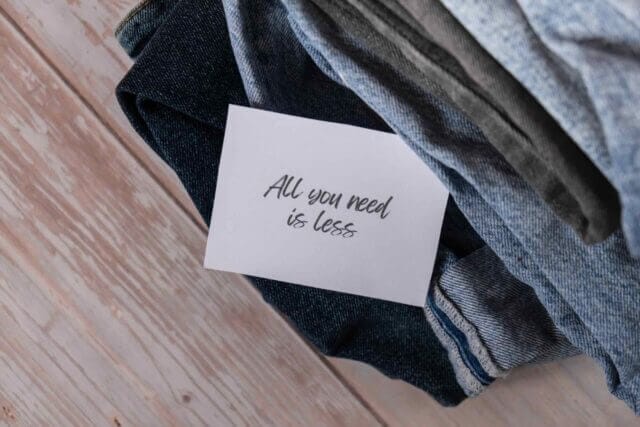
So that’s a general guideline for building a sustainable wardrobe which bridges new and second-hand shopping. Of course, this will be slightly flexible based on personal style, but these are 5 general rules to get you started:
- Consider the entire lifecycle of everything you buy, even if it is preloved
- Invest in versatile wardrobe staples that you will re-wear
- Start with what you already have – consider if your new purchase is cohesive with the rest of your wardrobe
- Let your fashion purchases be a reflection of you, not fast fashion trends
- Don’t let buying second-hand become a mask for overconsumption
Second-hand shopping is still one of the most important things we can do to be more sustainable, just as long as it does not replace mindful consumption. By engaging in a conscious approach to fashion, you not only reduce your environmental impact, but also improve your style. This happens as imposing limits on our consumption forces us to consider our personal style and get more creative with what we already have.
Towards a more mindful fashion future
Hopefully, by highlighting how this can be done through a combined approach of shopping for sustainable apparel and second-hand, our community of sustainable shoppers can work together to change our relationship to fashion and overconsuming. Then, together, we can tackle the enormous and destructive force that is fast fashion.
Did this article give you new ideas for building a sustainable wardrobe? Share it to support other people in their sustainable fashion journey.

Rhona is studying a Master’s degree in Global Development and Environment at the University of Bristol. She also works in sustainable retail and, in her downtime, enjoys reading, thrifting and yoga.


1 thought on “Second-Hand Fashion Sustainability: Why We Need to Rethink How (and Why) We Buy Pre-Loved Clothing”
Hi! I loved this article! such a thoughtful breakdown of why second-hand fashion really matters. The point about rethinking why we buy was especially impactful.
I’m just starting up my sustainable accessories brand, Millie Goat Bags, and I recently shared a post on why upcycling is considered sustainable and how it helps extend the life of materials. It felt really aligned with this topic, so I thought I’d share in case it’s helpful:
https://milliegoatbags.com/why-upcycling-is-considered-sustainable/
Thanks for such a great read!
– Camille, Millie Goat Bags