Michelle Fite is on a mission: She’s turning trash into high-end fashion.
Michelle founded Fite Fashion in 2018 when she saw a gap in the market for luxury, sustainable fashion. The brand combines couture techniques with deep respect for people and planet. Michelle talked to Eco-Stylist about her new ‘trash’ range, how she’s empowering women and what’s next for Fite Fashion.
Tell us about Fite Fashion
As a little girl I was always interested in fashion and I would try and make clothes for my Barbies. And I was always really fascinated with the psychology of fashion and how it is essentially non-verbal communication.
After I finished my bachelors in Fine Arts I was temporarily running a tuxedo rental store. In my downtime I was thinking about how many ways we approach fashion and retail and that experience.
For me, it was like aesthetically there’s a hole in the marketplace for fashion that is ethical, sustainable and also independently produced. That was really the foundation.
How can I show people that sustainable is sexy and professional and just as runway-worthy?
I’m a super creative person and I just gravitate toward the types of materials that you get to use in high-end fashion. I know a lot of those couture techniques. So as I’m trying to prove my point I’m also trying to carry forward these crafts that are always on the verge of dying.

How did you get interested in sustainability?
I’ve always been in awe, having my mind blown by nature. I don’t see a separation between myself and trees and critters. I like being part of the web of life.
The thing that I’ve wrestled with is how do I reconcile being compelled to create and the fact that creation requires resources. And the fact that the world does not need more clothing. So where I started, I would say that my current fabric choice surely could be more sustainable. It’s conventionally dyed but it’s made to order, it’s very high quality and I pay my people well. It’s been training wheels for me. The next phase of my work is going to be my real work and it will reconcile that issue that I’ve been wrestling with.
Let’s talk about sustainable couture: How do couture techniques and sustainability work together?
My next collection will be super obvious about that. I’ve been hoarding materials, using new tools and learning new techniques. I’m literally buying bags of broken jewelry so I can turn those into couture embellishments. I buy people’s bags of leather trash, scraps of sequins, broken jewelry.
I’m taking these couture techniques and I’m using trash. When I use these techniques I can transform that into something that looks like it cost $5000 and it’s trash.
What are you working on at the moment?
I have been taking all of the clippings from my seams when I’m sewing. I’ve been saving those and making my own tweed out of them. I’m going to show it to you. [Michelle holds up a clutch bag she’s made with her ‘trash tweed’ technique.]
This is tiny clippings from sewing. It’s literally the trash from the floor. I’m taking all this stuff that you can’t sew as is. I lay it out on the fusible and iron it. Then I take this scrap tulle and I put that on top and I abstract zig-zag stitch over it with netting on top just to make sure that everything stays. Then I can turn it into anything. So I’m going to make jackets and more clutches and bustiers out of it.
Eco-Stylist: It’s so beautiful. It looks like an abstract painting.
Yeah Jackson Pollack. If Pollack made tweed. I want to always have zero-waste accessories available. The accessories will always be the trash from the collections.

Which sustainability action are you most proud of?
It’s sticking with my guns on my goal being to consistently transition into more and more sustainable choices. To consistently move toward not just zero-waste but to be making a difference. To be able to say that I kept trash out of the landfill.
It’s taken a long time to source things and to learn how to use them. That is what I’m most proud of. The fact that I’ve stayed true to that original mission and what you’re going to see from me next is that expression.
I’m trying to prove that sustainable fashion belongs on a red carpet at the Oscars, it belongs on the cover of Vogue.
I’ve heard you talk about gatekeeping in fashion. How are you making fashion more inclusive?
I know couture techniques that they use in Paris. I have a Masters degree in fashion design. Even with my skillset I’m not getting a job in Paris.
The New York fashion houses work with the New York schools. There are a lot of people who can’t get into those schools because their parents don’t summer with the other people’s parents in the Hamptons. And it also is still excluding people of color and it is still not necessarily openly supporting the gay community.
I came up in the Punk Goth scene in the nineties and I’m very DIY about stuff. I don’t care about where you went to school, I care about can you do the thing?
Are you a good problem-solver? Do our brains work well together? Because I can train you in couture. If you’re able to build those skills I can do it and then you don’t have to go into the debt that I went into.
When I had an assistant she happened to be trans. I’m very inclusive with that. I also work with trans models. One of my favourite models happens to be trans and she is going to be the face of my couture, sustainable lingerie. That’s a way that I feel I can fight.
I’m also friends with a model who’s a disability advocate. She’s had a lot of health problems and she’s often in a wheelchair. Super photogenic, great to work with and I was like yes, when I’m able to I will have you on my runway. I will have you in my photo-campaigns. Those are the kind of people I want to surround myself with and I want to elevate. I just run an unabashedly female workspace. I’m circular. We all work together. I really value other perspectives.


What’s your personal approach to fashion and sustainability?
I always thrift everything first. I’ve been really excited about the company ThredUp. It’s women’s consignment and second hand. I always check there first. I grew up really poor and that is kind of where that stuff started. And as I got to become a teenager I was really developing that style. That was when Nirvana hit and Radiohead when I was fifteen. It was like a tsunami and I was there for it. I really resonate with PJ Harvey and Bjork and Siouxsie Sioux.
We tend to go through style phases before we can really settle upon what we really resonate with. Coming back to centre for me has been a lot of black and fairly minimal. Most of the time I’m not wearing makeup. I don’t wear jewelry all the time. Any bling you see – I have a lot of sequin skirts and little sequin dresses and things like that – they’re all thrifted. I’m somebody who plays a long game. I don’t mind digging for things.
What’s next for Fite Fashion?
My next fashion show is going to have a pretty intense warrior element to it because the world is asking me to fight. I surely hate the misogyny and I don’t know why any woman would vote for it and I don’t know why any woman in America would not vote this past election. And it makes me angry.
I want women to be scary. I want women to be obviously not molding themselves into whatever is happening right now.
To not dress for the male gaze. To own your power. If you walk into a room like you own the entire building people don’t question you. I love experimenting with that, it’s really fun.
The main crux of it is taking these materials and transforming them into something powerful. I want to inspire women to dress for themselves, to fight back and to and be over everything that tries to shrink.
What are you most excited about at the moment?
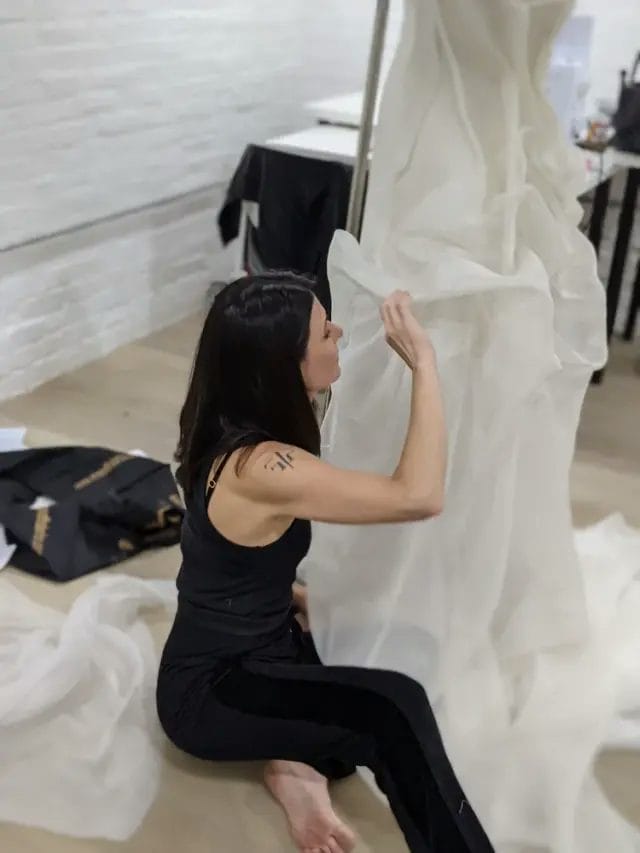
I think really showing myself that my persistence has led to the skills that I’ve always dreamed of having. It has taken a really long time to develop the skillset that I have. I got this tattoo so I couldn’t quit [Michelle has the Fite Fashion logo tattooed on her upper arm]. I’m really, really excited that I didn’t give up and I taught myself from Pinterest and YouTube and books and by being annoying and contacting people who I don’t know.
That I can create beauty that’s not at anyone else’s expense. That my success and that level of beauty doesn’t need to come with everything that it currently comes with: the exploitation of the Earth and the workers. I’m excited to share that perspective. I want a bigger platform to share that: what it’s actually like and why we should care about who makes our clothes.
What needs to change?
I like that there’s an increased backlash against fast fashion but I feel there’s still a lack of recognition that clearly shaming people doesn’t change their choices. There still is so much confusion. There’s so much greenwashing (check out our guide to learn how to identify greenwashing). And there’s so much of people starting a brand small and being bought by someone who doesn’t give a f**k.
I’m really glad that California passed their act about garment workers and trying to help create better working conditions for them. I want to be a part of those conversations. I want to support all of those types of facets of this industry that need to change.
My thing is proving that sustainable stuff is fashion because I don’t think that shaming people has been working.
I feel like fashion needs to hear that stuff a lot more. Who’s interviewing the people who work in the garment industry in New York or in LA? Who’s talking to them? Who’s really talking about how there still are sweat shops in this country? I want to use shame – not with the consumer – against other designers.
What’s your dream for Fite Fashion?
The end, dream goal is a couture house that is fundamentally, unabashedly female-run. That is sustainable and ethical from the beginning. I want to create something that isn’t about consumption. It’s about alliance. It’s about changing this industry from the inside. And I feel like the only way to really do that is to directly compete on the red carpet.
Check out Fite Fashion’s website to learn more!
More voices shaping the future of ethical fashion
To read more interviews with founders of ethical fashion brands, check out the interviews section of our blog.
If this story inspired you, share it with a friend—or tag us on social when you do. Every share helps spread the movement toward a more sustainable fashion future.

Catherine is a content writer based in London. She loves vintage, reading and swimming in the sea.